A Pull Request title is not a label.
It's part of your change control system.
In release management, major production issues rarely start with "bad code." They usually start with a lack of control over change. And one of the most underestimated elements of that control is… the Pull Request title.
Sounds trivial? Only until someone asks: "What exactly is in this release?"
In a mature environment, a PR isn't just a merge request. It's a formal unit of change. It connects:
Ticket → PR → Commit → Build → Deployment → Production
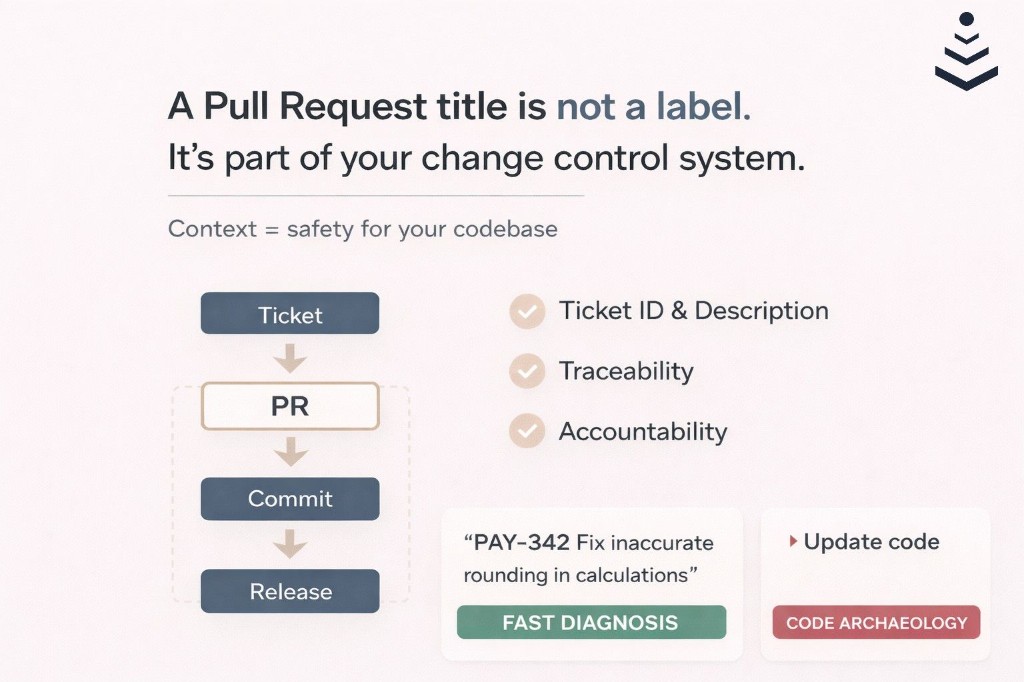
If a PR is titled "fix", "update", "changes" - you've already lost context. And in release management, context = safety.
At scale, improvisation breaks. With multiple repositories and environments, you need to quickly understand: Is this a feature or a fix? Is it safe for a hotfix branch? What business change does it represent?
A clear PR title allows:
- automatic release notes generation
- faster incident investigation
- better change failure analysis
- safer scope control
A vague one forces manual investigation - usually during a P1. When production breaks, time matters.
A PR titled PAY-342 Fix incorrect rounding in payment calculation is minutes to diagnose.
A PR titled quick update is archaeology under pressure.
Naming conventions aren't bureaucracy. They're a signal of engineering maturity. A well-written PR title is a declaration: This change has a clear scope. It's traceable. It's accountable.
And in complex environments, that difference matters.