Release Management and DevOps: Roles, Ownership and Governance in Enterprise Delivery
Who Protects Production?
DevOps, Release Management, and the Architecture of Responsibility.
In many modern engineering organizations, a subtle but critical shift has occurred. We have optimized for speed, automation, and autonomy - and in doing so, we have quietly complicated something far more important: responsibility.
DevOps changed how software is delivered. It reduced friction between development and operations. It automated infrastructure provisioning. It made continuous deployment not just possible, but normal. It allowed teams to ship faster than ever before.
But DevOps solved the execution problem. It did not fully resolve the ownership issue.
And those two are not the same.
The Question Behind the Process
When people discuss release management today, the conversation often sounds outdated. It conjures images of change advisory boards, manual coordination, scheduled release windows, and governance layers that slow innovation.
But the real question is not whether Release Management is "modern enough."
The real question is this:
Who owns production as a system? Not as code. Not as infrastructure. But in practice, it must remain stable while the organization evolves.
In small teams, this question rarely surfaces. One or two engineers know everything. Environments are simple. Dependencies are visible. Intuition is sufficient.
In larger systems, intuition stops scaling.
And when intuition stops scaling, structure must replace it.
DevOps Scales Technology. It Does Not Automatically Scale Responsibility.
Automation is powerful. A pipeline can verify build integrity. It can run tests. It can deploy artifacts deterministically. It can roll back to previous versions.
But automation validates artifacts. It does not validate alignment.
It does not ask:
- Are all dependent services compatible with this change?
- Has the same artifact moved consistently through environments?
- Is QA truly equivalent to production?
- Has environment drift accumulated silently?
- Are multiple teams coordinating promotions consciously?
These are not failures of tooling. They are failures of systemic visibility and ownership.
Over the years, I have seen technically perfect deployments that resulted in unstable production environments. Pipelines were green. Infrastructure was healthy. Logs showed no anomalies.
Yet production degraded. Why? Because release integrity had no explicit owner.
The Responsibility Diffusion Model
In growing organizations, responsibilities become distributed by necessity. Product owns scope. Engineering owns code. DevOps owns infrastructure and automation. QA owns validation.
On paper, it looks complete.
In practice, something subtle can emerge: a responsibility gap between components.
When no one explicitly owns release coherence across the system - version alignment, promotion discipline, dependency orchestration - instability does not appear immediately. It accumulates.
It accumulates as:
- Minor configuration changes applied manually.
- Hotfixes that bypass standard promotion paths.
- Version branches that are not merged back.
- Shared components released independently of dependent services.
- Environmental differences rationalized as temporary exceptions.
Each decision is reasonable. Collectively, they form structural fragility.
The Architecture of Responsibility
Stability is rarely lost in a single moment. It erodes. Quietly. Gradually. Almost politely.
At first, everything looks healthy. Deployments are fast. Pipelines are green. Dashboards glow with reassuring metrics. Teams move quickly and proudly speak about automation maturity.
And yet - somewhere beneath the surface - something is misaligned.
Production stability is not built on speed. It is built on layered responsibility.
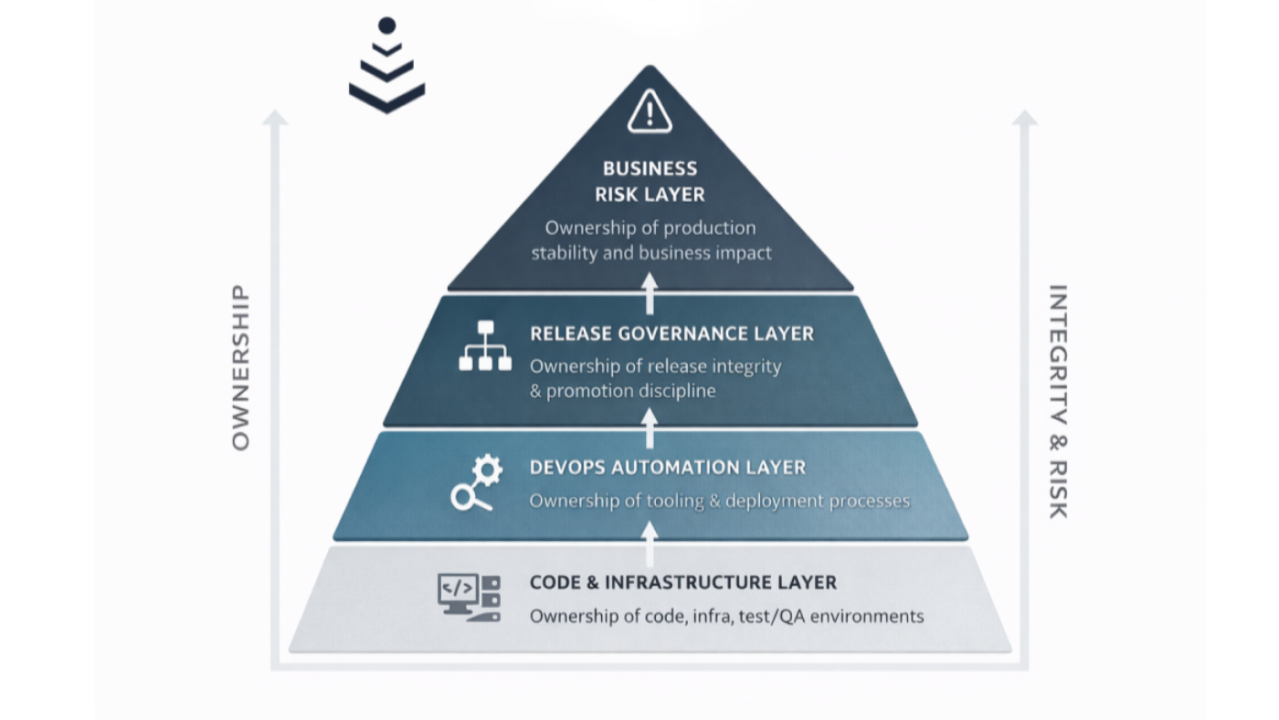
At the base of every system lies code and infrastructure - the tangible mechanics of delivery. Servers, containers, configurations, environments. This is the visible machinery.
Above it sits automation. Pipelines that move artifacts from one environment to another. Scripts that provision infrastructure. Processes that reduce manual effort. Automation makes movement possible. It creates momentum.
Most organizations stop their thinking here, but automation is not accountability.
Above automation sits something far less visible and far less glamorous: governance - the discipline of deciding what is allowed to move.
Governance is not bureaucracy. It is architectural intent applied to change. It asks questions that tooling cannot:
- Is this release coherent?
- Do these changes belong together?
- What is the blast radius if this fails?
- Who is responsible if a rollback is required?
Governance does not slow systems down. It defines the boundaries within which speed becomes safe.
And above governance sits the final layer - the business.
Not the roadmap. Not the sprint board.
The business.
Revenue. Reputation. Regulatory exposure. Customer trust.
When production fails, it is not a pipeline problem. It is a business problem. And this is where many organizations misunderstand the relationship between DevOps and Release Management.
DevOps ensures the machinery works. Release governance ensures that what flows through the machinery remains intentional.
When governance is weak, automation becomes a force multiplier for inconsistency. Small misalignments scale faster. Unclear ownership compounds. Mixed-scope releases become normalised. Speed increases. Confidence decreases.
When governance is strong, automation becomes leverage. Speed increases. Confidence increases with it.
The difference is subtle but profound. It is not about who clicks deploy. It is about who owns the integrity of motion.
True operational maturity begins when organizations realise that stability is not a tooling problem. It is an architectural one. Responsibility must be layered deliberately.
Automation without governance is velocity without direction. Governance without automation is control without movement. Only when both exist - clearly separated yet intentionally aligned - does an organization move fast and remain stable. And that balance is not accidental. It is designed.
When Roles Combine - and When They Should Not
It is entirely possible for a single individual to serve as both DevOps Lead and Release Manager. In smaller or mid-sized organizations, this can even be highly effective. When complexity is manageable and communication paths are short, merging these roles can reduce friction and accelerate decision-making.
However, this only works when clarity is intentional.
DevOps thinking is primarily oriented toward efficiency and execution reliability. It optimizes pipelines, infrastructure, and deployment mechanics. Release governance thinking, by contrast, is concerned with system-level integrity, version coherence, promotion discipline, and risk containment.
These are complementary perspectives - but they are not identical. If both mindsets coexist consciously within the same individual, the system benefits. Execution improves without sacrificing structural oversight. But when the distinction between the two roles blurs unconsciously, a subtle risk emerges. Tooling optimization may begin to dominate thinking, while governance concerns - which are often less visible and less measurable - fade into the background. And it is precisely this structural oversight that prevents slow-moving systemic drift.
The Drift Problem: A Precursor to Incidents
Most production incidents do not originate at deployment time. They are rarely caused by a single failed pipeline or an obvious technical mistake. More often, they result from small misalignments that accumulate over time.
A shared component is upgraded independently. A configuration differs slightly between environments. A promotion is bypassed due to urgency. A manual patch is applied "temporarily" and never fully reconciled.
None of these actions immediately breaks the system. Each one is locally rational. But collectively, they make the system increasingly difficult to reason about.
Over time, the gap between what teams believe is running and what actually is running widens.
When an incident eventually occurs, the response often turns into reconstruction. Teams search Git repositories, review CI logs, cross-reference issue trackers, inspect environment variables, and rely on institutional memory to piece together the sequence of changes.
If understanding the production state requires digital archaeology, the organization lacks operational visibility. It possesses institutional guesswork. This is not a DevOps failure. It is the absence of explicit release governance.
Enterprise Context: Where Trust Becomes Structural
In regulated or enterprise environments, the stakes change. Questions arise that automation alone cannot answer:
- Can you demonstrate what was running on a given date?
- Can you prove which version was validated before production?
- Can you trace approvals?
- Can you show that environments were aligned?
These are not technical questions. They are structural ones. Mature organizations understand that speed without traceability erodes trust. And trust, once eroded, is far more expensive to rebuild than any pipeline.
The Maturity Transition
Organizations typically move through distinct phases: First, they automate deployment. Then, they optimize pipelines. Then, they introduce environmental awareness. Eventually, if they evolve far enough, they recognize that governance is not bureaucracy - it is architecture.
At that stage, Release Management is no longer perceived as coordination. It becomes a stability abstraction layer. It is the mechanism that ensures that speed does not outpace understanding.
A Closing Reflection
Over the years, I have observed a pattern. The organizations that move fastest are not always the ones that survive complexity. The organizations that endure are those that make responsibility explicit.
DevOps changed how we deliver software. Release governance determines whether delivery remains sustainable.
The question is not whether we need DevOps or Release Management; the question is whether we need both. When complexity exceeds intuition, who ensures production remains coherent?
Because when responsibility is explicit, systems scale. When responsibility is diffused, risk accumulates silently. And, eventually, production reflects that structure.